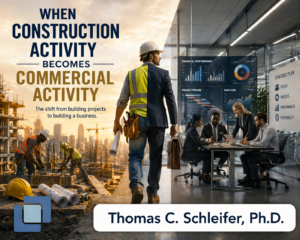
This week we will be discussing the distinction between construction activity and commercial activity. Many contractors start their careers working with the tools and because of the unique nature of the construction financial transaction (contracting for one new job after another rather than a continuous flow of ongoing financial transactions) quickly grow into business owners and managers before they realize it. Therefore, they rarely see business management as a science distinct from construction management.
The Science of Business
Business is the purposeful pursuit of profit through the commercial activity of satisfying customer needs at a cost that is less than the selling price. To be classified as a business, an enterprise typically exhibits several key traits:
- Profit Motive: Financial gain after all costs are paid.
- Economic Activity: Continuous transactions rather than isolated exchanges.
- Risk & Uncertainty: Business inherently involves the risk of loss or market shifts.
- Value Creation: Provide a good or service that satisfies a societal need or want.
Construction, farming, manufacturing, transportation, and finance are not businesses until they are turned into commercial activity which is the job of business managers.
The Unique Business of Construction
Although construction activity seems to be a basic instinct of crafty human intelligence, there is nothing simple or commonplace about the “business” of construction.
- There are over 3.7 million construction businesses in the U.S. ranging from independent contractors to large firms.
- There are few publicly traded construction companies.
- The industry has 8 million employees and creates nearly $2.1 trillion worth of structures each year.
- The market size of the U.S. construction sector was valued at $2 trillion in 2023 and the value of construction put in place should reach $2.2 trillion next year.
- Considering the size and economic impact of the construction industry it is almost inexplicable that the industry has never availed itself of the “free” public capital that has fueled the growth of every other American industry.
- The construction business does not enjoy a continuum of financial transactions like manufacturing or retailing. Rather, contractors’ “contract” for all future transactions one after another.
- No transactions alike leave little continuity to the business learning curve.
- Construction is not paid for at the point of sale but collects partial progress payments after the work has been completed. This, of course, requires contractors to provide an ample supply of working capital.
- Since contractors do not own what they build, they are unable to leverage its value to raise the working capital they are required to supply to build it.
- Projects acquired through an ancient “low-bid” competitive auction put self-limiting downward pressure on profit margins.
- Having to do things again because they weren’t done right the first time can be a frustrating experience for anyone. But in construction, rework isn’t just a hassle—it’s a very expensive problem. Industry data shows that rework costs firms in the United States over $177 billion annually and it can represent up to 20% of total project costs.
A Commercial Activity
Most contractors believe they are business managers simply because they are immersed in construction activity. The irony is that construction is not a business until it is turned into a commercial activity.
Because they lack formal business management training, contractors usually overlook the following fundamental business management elements necessary to turn construction activity into commercial activity.
- Utilizing an independent board of directors. (Not dominated by insiders)
- Including your Chief Financial Officer in senior management decision making.
- Creating and adhering to a strategic plan.
- Carefully measuring ongoing financial results against budgeted guidelines.
- Utilizing balance sheet metrics to measure financial performance and manage risk.
- Accounting for individual project profit and loss after closing out a project and all costs are in (including punch list) is the only accurate indicator or earnings.
- Managing working capital through advanced planning and banking relationships.
To mention only a few.
Much of this year will be devoted to discussing the distinction between construction activity and commercial activity and helping to understand the elements that turn construction activity into commercial activity.
For more information on bid commercial activity, read more at: ACTIVITY
For a broader view of financial management, read more at: MANAGEMENT
To receive the free weekly Construction Messages, ask questions, or make comments contact me at research@simplarfoundation.org.
Please circulate this widely. It will benefit your constituents. This research is continuous and includes new information weekly as it becomes available. Thank you.