“If you don’t know where you’re going – you’re probably not going to get there.”
I quote this ancient Chinese proverb every time I talk about strategic planning. The contracting business does not lend itself to long-term planning. Unlike most industrial companies who rely on a consistent revenue stream as a basis for future planning, contracting’s intermittent revenue stream is almost impossible to predict beyond the work that is already booked and in progress. Since contractors can never be sure how much money future unsigned contracts might represent, many consider it a waste of time predicting long term business activity beyond the revenues from existing work in progress. Some might include a guess at potential revenues from contracts they are likely to sign and most can’t be bothered to put in the time and effort to write a 5-year plan.
Financial Planning
Financial planning is budgeting. It reduces business activity to precise financial metrics as a guide for the business to “hit the numbers”. A yearly “budget” makes sense to contractors, but five-year plans are impossible in their mind. And they are right. Five-year financial plans alone are impossible in the construction business.
Strategic Planning
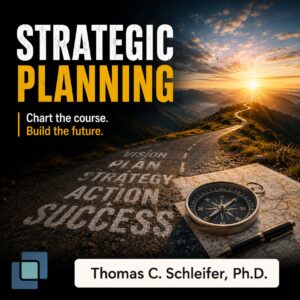
Strategic planning is not financial planning. Strategic planning is an ongoing mental organizational process used to point the company in a direction and help management and employees share goals, establish priorities, and allocate resources so that everyone’s daily actions support the company’s ultimate vision.
The human mind is a natural strategic planner. In elementary school you perhaps started thinking about where you wanted to go to high school based on what college you would like to attend based on what career you had in mind. If so, you were strategic planning in elementary school. I could give you literally hundreds of other examples of the natural mental process of strategic planning.
In The Beginning
When engaged to mentor young contractors who had suddenly found themselves at the helm of their family’s contracting firm, I always asked them their vision of where they wanted to take the company in the future. I was trying to make them aware at the outset that, whether they knew it or not, they already had a personal vision of the future. I wanted to ignite the natural strategic plan that all human beings nurture inwardly.
A Natural Process
The strategic planning process that is natural to human intelligence is a simple three step process.
- Define your vision (the future state you want to create).
- Conceptualize how your organization can actualize your vision of the future. This is your organization’s mission (why your organization exists).
- Finally, identify your organization’s values. These will be the principles that guide your decisions and serve as the compass for your strategy.
As soon as you focus on your company as the engine of your future vision, a strategic plan begins to form naturally in a healthy mind. Your “wants” morph into “goals” and you begin to define the values needed to guide you to your future vision or end goal.
Formal Strategic Planning
Business professionals have designed a formal strategic planning process that is utilized across all industries. It is designed to extract the already formulated vision of the company’s future residing in the mind of the owner, CEO or Board of Directors, and codify it by reducing it to an action plan and then communicating the shared mission to the entire company.
This formal planning process works best when a team of top managers representing all key company functions takes time away from the daily chores of running the business to plan their future.
Next Week
Next week we will go through the step-by-step process required to create a powerful Strategic Plan and how to implant the resulting shared mission down through every department of the company. Success is often defined as achieving your objectives. A carefully conceived Strategic Plan is the magic potion of success.
Because…
“If you don’t know where you’re going – you’re probably not going to get there.”
Note: My latest book, Construction Business for the 21st Century—Managing Risk and Improving Profits getting rave reviews.
For more information on strategic planning, read more at: PLANNING
For a broader view of vision, read more at: VISION
To receive the free weekly Construction Messages, ask questions, or make comments contact me at research@simplarfoundation.org.
Please circulate this widely. It will benefit your constituents. This research is continuous and includes new information weekly as it becomes available. Thank you.