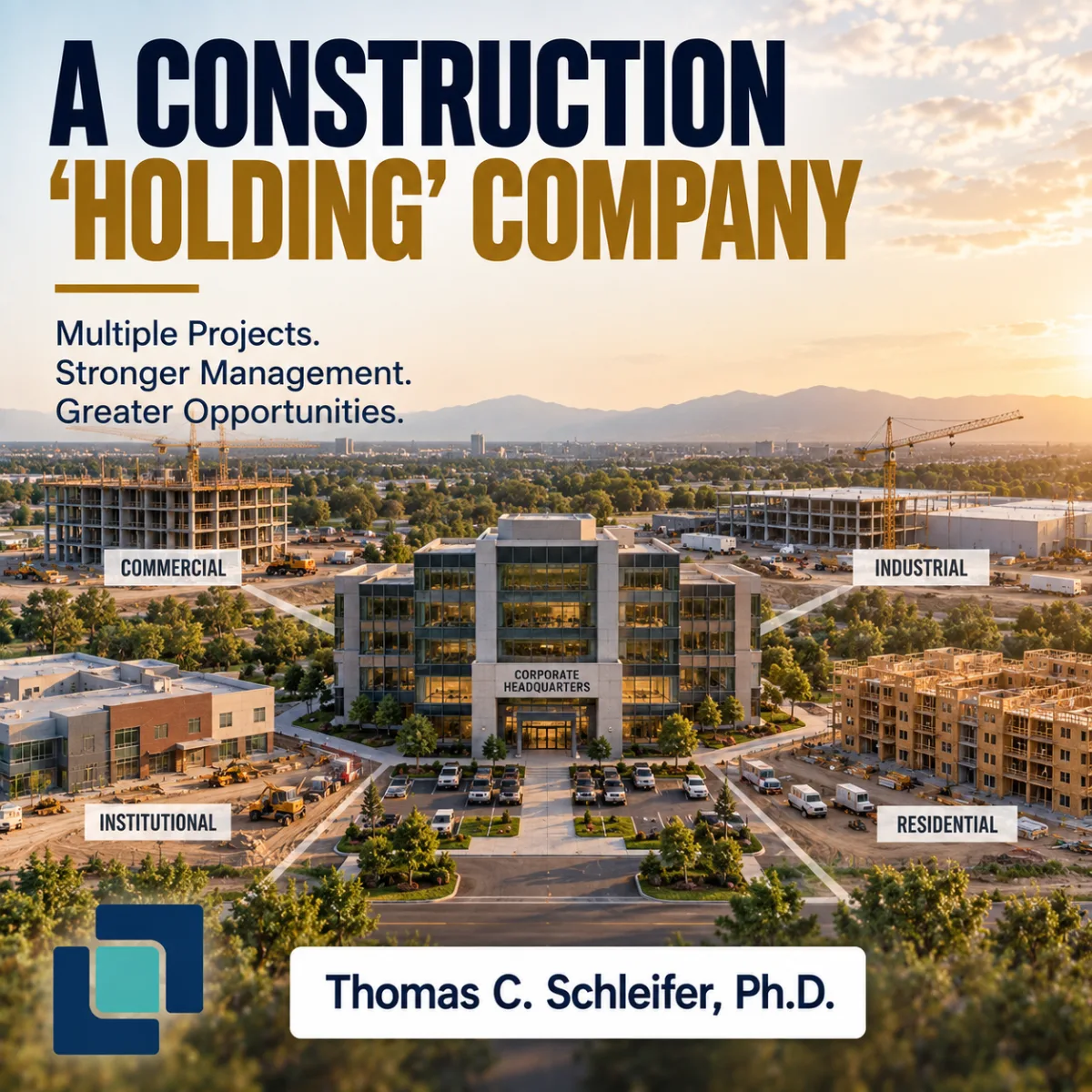
The post-WWII economic boom saw giant corporations dominating the economic landscape. By the late 60’s this corporate expansion was being accomplished by a wave of mergers and acquisitions that resulted in new corp. entities known as “holding companies”. They purchased diverse corporate entities leaving the existing management in place to run the business as a wholly owned subsidiary.
Large General Contractors as Regional Leaders
When a general contractor reaches regional leader status the firm often resembles a classic holding company. Each project had its own risk profile, schedule, labor plan, subcontractor network, and cash requirements. Trying to manage this group of projects as one operating entity is difficult. Similar to a holding company these contractors treat each project as a wholly owned operating subsidiary. Projects are managed, measured, and governed as a distinct business unit. The aim is not to fragment the company; it is to create accountability for the work while preserving the purchasing power, expertise, and financial strength of the organization.
The “Home Office” Contractor’s Role
Under a “holding company” business model, the home office functions like an investor and shared-services platform with responsibilities for business development, bonding capacity, banking relationships, insurance, human resources, safety standards, and executive oversight. It also establishes the company’s operating playbook: estimating standards, budget formats, approval limits, and controls for changes, commitments, and payments. In this type of organization corporate leadership must resist the temptation to make every field decision. The home office role is to provide governance and resources, not to remove ownership from project leaders. Instead, it should define clear performance expectations and intervene when key thresholds are missed.
Treat Each Project as a Discrete Business Unit
- Every substantial project should begin with an approved business plan that includes the original estimate, labor assumptions, procurement schedule, cash-flow forecast, target margin, contingency plan, and closeout strategy. Each project has a separate profit (loss) statement.
- The project team operates like an executive team of a subsidiary. The PM is the business-unit leader, the superintendent controls field production and safety, and the in-house accountant manages cost reporting, forecasts, and billing.
Separate Accounting is the foundation of a holding-company model.
- Each project has its own budget, labor report, revenue forecast, work-in-progress schedule, accounts receivable aging, and cash-flow projection.
- Revenue recognition and cost-to-complete forecasts should be updated consistently, ideally every month and more often for complex or distressed work.
- The key measure is not a budget. Management should track estimated against actual costs, projected gross profit, earned revenue, change-order status, and retainage. Projects can appear profitable on paper while consuming excessive cash or carrying unrecognized risk. Separate reporting exposes those conditions.
- Corporate accounting should consolidate project statements into a company-wide view. This allows leadership to see which projects are generating cash, which require support, where contingencies are shrinking, and whether total backlog is producing the returns anticipated. Consolidation should never erase project-level accountability; it should clarify it.
Approval Authority should match the risk.
- Routine decisions belong with the project team while settlement offers, unbudgeted commitments, and material schedule changes require escalating levels of corporate review. This prevents corporate micromanagement while ensuring that significant exposures receive experienced scrutiny.
- Capital discipline is equally important. Management should evaluate projects based on return on capital, not just gross margin. A project with a strong margin but severe working-capital demands, slow collections, or unusual guarantees may be less attractive than a faster-paying project with lower profit. This perspective improves bidding selectivity and protects the corporate balance sheet.
Centralized Services give projects capabilities they could not efficiently maintain on their own. Safety, quality assurance, scheduling support, purchasing intelligence, and equipment management should be available from the parent organization.
Transparent Accountability
This model succeeds only when reporting is candid.
- Project leaders are rewarded for identifying risk early, not for delaying bad news.
- Forecast changes are treated as new information rather than personal failure.
- When a project misses expectations, leadership should conduct a structured review of estimating assumptions, procurement timing, design coordination, labor productivity, client behavior, and decision quality.
Lessons learned improve the whole company. Strong project practices can be standardized, recurring problems can be addressed in preconstruction, and leadership can allocate talent and capital to markets and project types that create durable returns. Managed this way, a contractor becomes a portfolio of accountable operating businesses backed by a disciplined central office.
For more information on project accountability, read more at: ACCOUNTABILITY
For a broader view of construction business management, read more at: BUSINESS
To receive the free weekly Construction Messages, ask questions, or make comments contact me at research@simplarfoundation.org.
Please circulate this widely. It will benefit your constituents. This research is continuous and includes new information weekly as it becomes available. Thank you.