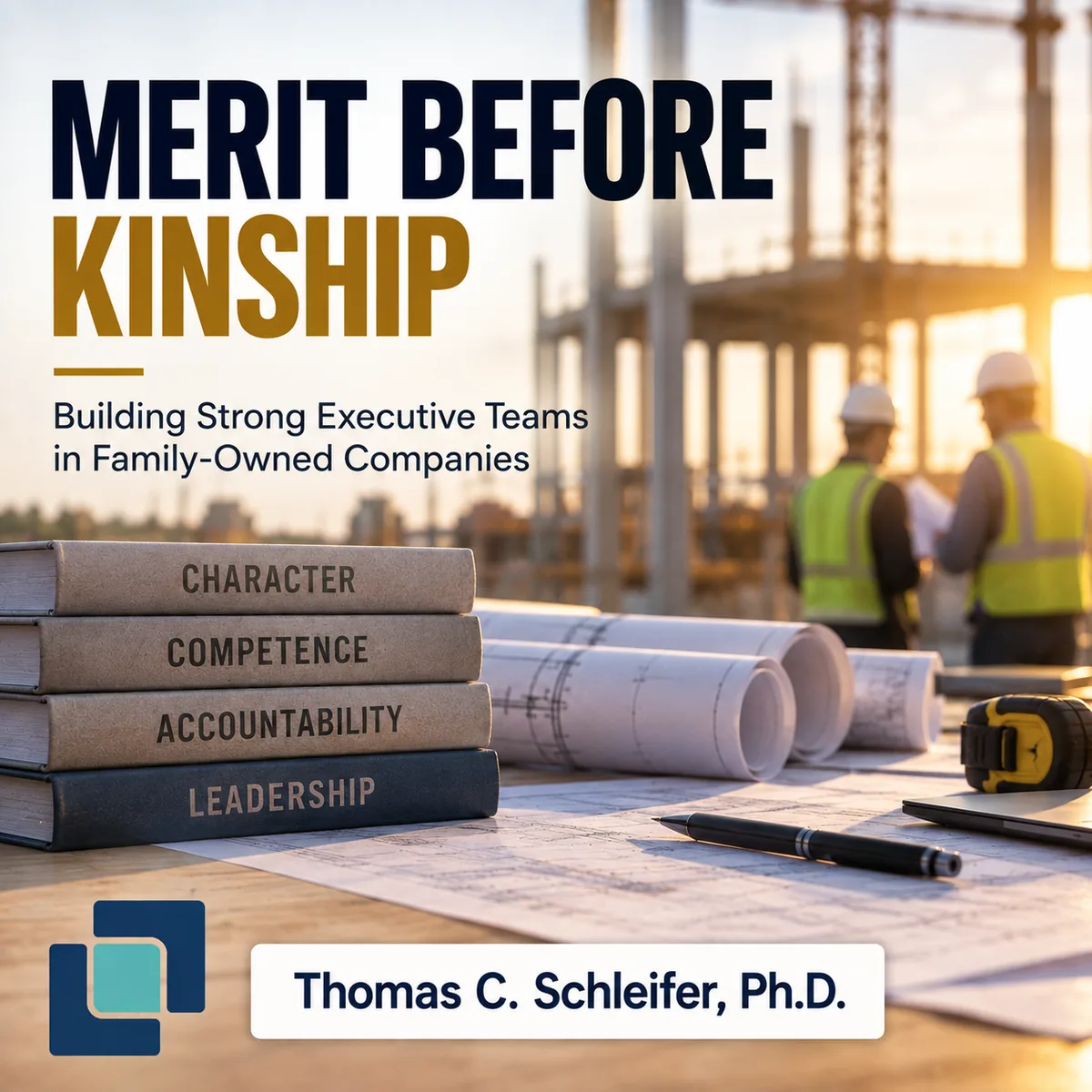
Building Strong Executive Teams in Family-Owned Companies
Family-owned construction companies often possess strengths that larger competitors struggle to replicate: long-term commitment, strong local reputations, quick decision-making, and a deep personal investment in quality. Yet those advantages can be undermined when senior roles are filled primarily because a candidate is related to the owners rather than qualified to lead. In an industry where project margins, safety performance, bonding capacity, client confidence, and operational execution are interconnected, an unprepared executive can create consequences that last far beyond one job. The solution is not to exclude family members from leadership. It is to establish a system in which family members earn leadership opportunities through clear standards, preparation, and accountability.
Consultant: Throughout my career as a consultant to contractors many of the assignments were to smooth the succession from original founders to the inexperienced family members who were taking over the business. I often stayed on as temporary advisor for 3 to 5 years until I could staff the executive positions with competent candidates or train the family member successors in the most basic construction business management techniques. In every case it was necessary to completely change their deeply held beliefs from the entitlement of kinship to the empowerment of merit.
From Kinship to Merit: Step 1 – Define Executive Positions
The first step for these legacy family-owned companies was to define each executive position as a critical business role rather than a family entitlement. Written job descriptions make it harder to justify appointments based on family status alone.
To accomplish this:
- The company should document the responsibilities, technical knowledge, leadership expectations, and measurable results required for positions such as president, CFO, operations leader, chief estimator, and safety executive.
- A future CFO, for example, must be able to manage cash flow, understand work-in-progress reporting, maintain lender and surety relationships, and interpret project-level financial risk.
- A future operations executive must demonstrate the ability to lead project managers and superintendents and resolve schedule issues, protect quality, and uphold safety standards.
Step 2 – Formal Entry Requirements:
The second step is for family businesses to adopt formal entry requirements for relatives who want to join the company.
- These requirements may include relevant education, field experience, professional credentials, and a demonstrated record of performance.
- Construction is especially well suited to development paths that require family members to learn the business from the ground up. Someone who aspires to an executive position should spend meaningful time in the field in estimating, project management, procurement, finance, and client relations. That experience creates credibility with surety, bankers, and employees and produces leaders who understand how their decisions affect crews, subs, schedules, and customers.
- Outside experience is extremely valuable. Requiring prospective family executives to work successfully for another contractor or related business for a number of years reduces the risk of sheltered development. It gives them exposure to different systems, leadership styles, and performance expectations. More importantly, it demonstrates that they can earn promotions and respect without the family name opening every door. When they return, they are more likely to contribute new ideas and less likely to be viewed as a protected insider.
Step 3 – Board of Directors:
Independent governance provides important safeguard.
- A board of advisors or formal board of directors can bring objective judgment to executive hiring, promotions, compensation, and succession planning. Members may include experienced construction executives, financial professionals, surety or banking specialists, and trusted business leaders. Their role is to give the family credible outside counsel particularly when decisions become emotional.
Step 4 – Open Competition:
Family companies should also commit to open competition for key executive jobs.
- A family candidate can apply but should compete against qualified internal and external candidates.
- Search committees can evaluate candidates against a consistent scorecard, including industry expertise, leadership record, financial judgment, culture fit, and strategic capability.
- If the family member is the best candidate, the process strengthens confidence in the decision.
- If another candidate is stronger, the business gains a capable executive while the family member gains a clearer development path rather than an unearned title.
Step 5 – Separating Ownership from Management is a critical distinction.
- A family member may be a valued owner and still not be ready to run a major department or the entire company. Ownership can provide financial returns, voting rights, and a voice in long-term strategy without automatically granting operational authority. This distinction protects both the company and the individual. It allows family members to contribute in areas suited to their abilities while preserving executive roles for leaders who can carry the responsibility.
Step 6 – Maintaining Fairness communicates that it is a company principle.
- Non-family employees will stay, grow, and bring forward their best ideas when they believe advancement depends on performance.
- Clients, lenders, sureties, and trade partners also gain confidence when leadership appointments reflect competence.
Summary:
A family-owned business does not have to choose between legacy and professionalism. By defining roles, requiring preparation, measuring performance, using independent advice, and separating family relationships from executive qualifications, it can preserve its heritage while building a leadership team capable of sustaining the business for generations.
Next week we’ll discuss how organizational structure depends on company capacity.
For more information on succession planning, read more at: SUCCESSION
For a broader view of boards of directors, read more at: DIRECTORS
To receive the free weekly Construction Messages, ask questions, or make comments contact me at research@simplarfoundation.org.
Please circulate this widely. It will benefit your constituents. This research is continuous and includes new information weekly as it becomes available. Thank you.