If you have not read last week’s message you should go back and read it at least twice, take notes, think about it and talk to other employees about it. Internalize as much of the content as you can and then read today’s blog.
Wandering
Effective business management in the construction industry starts with a well thought out and executed strategic plan. I can’t say it any plainer than that because without a strategic plan, missteps are inevitable. Starting or building a construction company without a strategic plan is like starting a cross-country road trip without a road map. You drive along without mishap if you pay attention and stick to the pavement, but you’re not sure if you’re heading toward or away from your destination. If you don’t get into an accident, just the act of driving without interruption begins to feel like success. Similarly, because of the intermittent nature of the business, too many construction professionals have no goal in mind beyond completing the current jobs and looking for the next. Just keeping going is success.
Keeping Going is Enough…Until it Isn’t
The aimless cross country auto journey is similar to how many construction professionals experience their business careers. They haven’t mapped out their goals but feel as long as they’re getting from one job to the next that’s good enough. To them “top-line” growth feels like success and, if they’re growing, they are succeeding. The problem with this “feeling” is that it is not true. “Top-line” growth is not necessarily progress toward your goal but can often be the opposite. In construction, where contractors finance as well as build the projects, top-line growth can exceed a contractor’s capital capacity. This is a major risk factor that regularly leads to the collapse of entire enterprises. You can’t reach your destination by going faster and faster in the wrong direction. You can only get there if you map out a carefully planned route, known in business as a strategic plan.
Execution
Executing a carefully conceived strategic plan is less about producing a polished document and more about converting intent into coordinated field action. Because construction work is project-based, multi-employer, and exposed to shifting conditions—weather, labor availability, design changes, and material lead times; execution requires a disciplined operating system that connects leadership decisions to jobsite behavior. Firms that excel do not merely “roll out” a plan; they translate it into priorities, measurements, and routines that keep crews, subcontractors, and clients aligned even when pressure rises.
Control Ambition
A strategic plan often contains many ambitions: growth, new markets, safety, schedule reliability, quality, technology modernization, and/or stronger margins. Trying to execute everything at once is a common failure mode. Leadership should narrow the plan to a small set of enterprise priorities (usually three to five) that will matter most over the next 12–24 months.
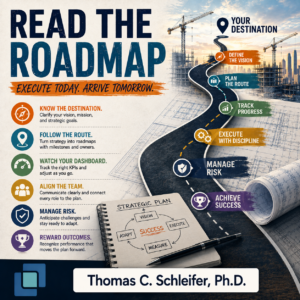
Read the Roadmap
Next, convert each priority into a practical roadmap with milestones and resources. Execution stalls when strategy is assigned to “the organization” rather than to named accountable people. For each outcome, the company should identify an executive sponsor, a responsible manager, and the cross-functional team required to deliver it—estimating, operations, safety, procurement, project controls, and finance.
Watch Your Dashboard
Strategy must be translated for each level of the organization. Executives need dashboards and risk signals; project managers need playbooks; superintendents need simple jobsite standards; foremen need daily expectations; and subcontractors need clear scope, schedule commitments, and quality criteria.
Risk Management
A carefully conceived plan requires disciplined risk management and change control. Execution is vulnerable to “scope drift” as opportunities and crises appear. Leadership should adopt a simple rule: strategic activities get funded and prioritized only if they advance the chosen outcomes, and any major deviation requires explicit approval.
Attach Rewards to Outcomes
In construction, the jobsite is where the truth is revealed: safety, quality, and productivity show up in observable behaviors. If you reward only revenue and speed, you will get shortcuts and claims. If you reward predictable planning, disciplined documentation, and collaboration, you will get repeatable performance. Compensation, promotion, and recognition programs should reinforce the strategic outcomes—especially for project leaders who shape the day-to-day execution.
How to Get Where You’re Going
In short, executing a strategic plan in construction means building a management system that connects strategy to project realities: clear outcomes, accountable ownership, resourced roadmaps, practical communication, disciplined change control, workflow-based implementation, aligned incentives, and continuous learning. When these elements are in place, the plan is no longer a document—it becomes the way the company builds.
For more information on executing a strategic plan, read more at: EXECUTING
For a broader view of the dangers of top line growth, read more at: TOP LINE
To receive the free weekly Construction Messages, ask questions, or make comments contact me at research@simplarfoundation.org.
Please circulate this widely. It will benefit your constituents. This research is continuous and includes new information weekly as it becomes available. Thank you.