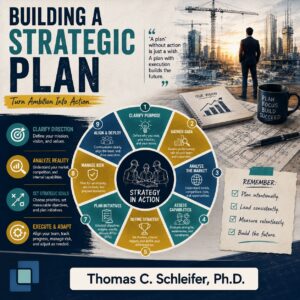
The strategic planning that we have been discussing can be converted into a highly effective business management tool by turning ambition into a definite action plan.
What Strategic Planning Decides
The strategic planning process identifies what markets to pursue, how to win work, how to build safely and profitably, and how to scale capacity without losing quality. Because construction is project-based, cash-flow sensitive, and exposed to labor and supply volatility, the plan must be developed with clear assumptions, measurable goals, and assignments of responsibility.
The Seven-Step Process
These steps outline a practical, disciplined way to build a strategic plan that every growing construction firm should implement.
Step 1: Begin the planning process by clarifying “why” your company exists and “how” you define success.
- Craft what is known to business academics as a mission statement which is nothing more than a statement of what you do and for whom.
- Then write a vision statement, which is a simple statement of where you want to be in three to five years. (For example, a company may decide its purpose is to deliver mid-sized commercial projects with reliable schedules and high safety standards, and its vision is to become the preferred contractor for repeat clients in two metro markets within five years.)
- Finally, choose the planning horizon–typically 3 to 5 years with annual updates and non-negotiable standards in safety, ethics, quality, and financial discipline.
Step 2: Strategic planning is only as good as the data behind it.
- Assemble baseline metrics from the last two to three years: revenue and gross margin by project type, win rate, backlog quality, change order performance, schedule variance, safety incident rates, rework and warranty costs, labor utilization, equipment uptime, payment cycle, and claims history.
- Interview project managers, superintendents, estimators, key subcontractors, and a handful of customers to understand what is working and what is failing. This diagnosis often reveals soft spots such as inconsistent estimating, weak preconstruction, or overextension into unfamiliar work types.
Step 3: Analyze the external environment.
- Identify demand drivers (public funding, industrial expansions, housing trends); competitive dynamics (regional GCs, specialty contractors, design-build firms); and owner preferences (low bid versus best value, prequalification requirements).
- Evaluate regulatory issues, permitting timelines, union or labor conditions, and supply chain risk for critical materials. Track technology shifts—advances in scheduling processes, digital field reporting, prefabrication, and project delivery models. Describe the environment as it is, not as you wish it to be.
Step 4: Assess internal capabilities and constraints. Strategy must match capacity.
- Evaluate people (depth of superintendents, PM training, leadership bench) processes (estimating accuracy, scheduling discipline, change management) equipment, safety culture, and financial strength (bonding limits, working capital, access to credit).
- Identify the company’s differentiators (things like strong self-perform crews, excellent owner communication, or superior closeout discipline).
- Identify constraints like the bottlenecks that limit growth, such as a thin preconstruction team or inconsistent subcontractor management.
Step 5: Establish strategic themes and positioning.
- Typical themes include: “focus on repeat clients,” “expand into design-build,” “improve productivity through standardization,” “grow profitably in healthcare.”
- Positioning must be specific: which sectors to target, project sizes, which geographies to serve, and what value proposition differentiates the firm. This prevents the mistake of chasing every opportunity and diluting execution.
Step 6: Set objectives and key results with measurable outcomes.
- Objectives might include increasing gross margin by two points, reducing recordable safety incidents by 30%, improving schedule performance to a defined threshold, or growing backlog in target sectors.
- For each objective, define key results and leading indicators such as:
1. Estimate-to-actual variance.
2. Subcontractor performance scores.
3. Days sales outstanding.
(Construction firms benefit from blending financial targets with operational and safety outcomes so growth does not come at the expense of risk.)
Step 7: Build initiative roadmaps and allocate resources.
- Examples include creating a formal preconstruction process, standardizing project startup checklists, expanding safety training, or developing strategic subcontractor partnerships.
- Each initiative needs a clear owner, a timeline, a rough budget, and expected impact. (Also, decide what you will stop doing—such as bidding projects outside your sweet spot—so resources are not spread too thin.)
Step 8: Create a risk management and scenario plan. Construction is exposed to uncertain inputs: labor availability, material lead times, interest rates, different types of owners, and new funding methods.
- Build scenarios (base, upside, downside) that test backlog and cash needs.
- Define risk controls; bid/no bid criteria, contract review standards, contingency policies, bonding limits, and escalation procedures for schedule and cost threats. (A plan that ignores risk is not strategic; it is optimistic.)
Step 9: Communicate, align, and deploy. (Plans fail when they stay in the boardroom.)
- Translate the strategy into clear expectations for estimating, operations, and business development.
- Hold rollout sessions with field leaders, explain the “why,” and show how daily decisions connect to strategic goals.
- Translate objectives into team-level targets—for example: foremen focusing on productivity tracking, PMs on change order cycle, estimators on bid accuracy.
Step 10: Track execution and refresh routinely.
- Conduct monthly performance reviews tied to dashboards, quarterly strategy check-ins, and an annual refresh.
- Celebrate progress, correct drifts quickly, and update assumptions when the market shifts. (Over time, the company builds strategic muscle: it learns, adjusts, and compounds improvements.)
A step-by-step strategic plan is not a one-time document; it is a management system. For a construction company, the best plan is practical, measurable, and aligned to capacity—turning market opportunity into safe, repeatable, profitable execution.
For more information on setting objectives, read more at: OBJECTIVES
For a broader view of risk management scenario plans, read more at: RISK PLANS
To receive the free weekly Construction Messages, ask questions, or make comments contact me at research@simplarfoundation.org.
Please circulate this widely. It will benefit your constituents. This research is continuous and includes new information weekly as it becomes available. Thank you.