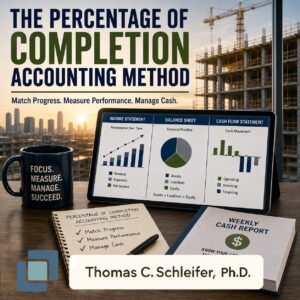
The unique nature of the construction financial transaction (total revenues contracted for rather than collected at the point of sale) demands that the three traditional financial statements we have been discussing these past weeks be prepared using the percentage of completion accounting method. This method ties revenue and expense recognition to the level of project completion, which can result in billings that exceed costs–or costs that exceed billings. This alignment of revenues and expenses with the project’s percentage of completion, instead of basing it solely on actual expenses incurred, attempts to track as closely as possible whether the company is operating profitably, as it works its way through the project. Traditional accounting documents are produced monthly, using the matching cut-off at the end of each month.
Problem
Strictly speaking in classic double entry bookkeeping, there is no room for “as closely as possible”. However, because of the nature of construction, revenues can be properly recognized as earned only after the project is complete and signed off. Because of the extended timeframe of construction contracts, the industry had to find a way to track and report profit or loss for work in progress as projects moved along. Without it outside stakeholders like banks and sureties would be unable to extend informed credit to contractors.
So, the accounting industry came up with the percentage of completion accounting method. Unfortunately, this method must rely on estimates to arrive at revenue so matching it with expense monthly is never completely accurate. Therefore, the resulting monthly profit is estimated. Contractors and the accounting profession are aware of this flaw but are unconcerned because they contend that the hard profit numbers come out at the end of a project when the final revenues are paid and all the expense invoices have been satisfied.
Accurate Instruments
Could the pilot of a 747 safely guide the aircraft to a soft landing if the altimeter or the vertical speed indicator were only estimates of the data they displayed in the cockpit? Their chances of landing the aircraft safely would be in jeopardy.
This is why many contractors refuse to rely on traditional financial statements to manage their day-to-day business. They know that interim (monthly) financials are, at best, estimates of actual financial status, because they themselves use percentage of completion accounting to “front load” progress payments as a method of cash flow management. In other words, they participate in the estimated data so they know that their instrument panel (financial statements) is not exact so they go back to looking out the window of the plane for landmarks to navigate the company to a soft landing. This is why contractors don’t need to be instrument rated.
A Fourth Financial Instrument
The experienced construction CFO is aware of this dilemma. For reporting purposes, they diligently prepare the three traditional monthly financial reports (Profit and Loss, Balance Sheet, Cash Flow Statement) using the generally accepted percentage of completion accounting method. The CFO assures that these reports to outside stakeholders (banks, sureties, tax authorities) are accurate within a reasonable margin of error for credit evaluation and tax designation purposes. However, because they do not utilize actual cash transactions to determine interim (monthly) financial status and may not be able to match revenues and expenses at a hard cutoff date, they can lose track of their cash position and run out of money in the middle of a project.
To keep careful track of a construction business’s capital position, a fourth instrument must be added to the three traditional financial reports that are created using the percentage of completion accounting method.
The Cash Report
Different CFOs use slightly different names for this instrument, but I refer to it as the Weekly Cash Report. Some industries prepare a daily cash report. There is nothing sophisticated about this fourth financial report. It is simply a weekly record of every cash transaction that occurs. No estimates and nothing omitted for any reason. Each entry is made to a double entry bookkeeping accounting ledger that must always be in balance. No profit or loss calculation can be made from this statement because there is no attempt to match revenues and expenses at a given moment in time. This document is created for the sole purpose of allowing the CFO to know their cash position weekly so they can take or advise corrective action if cash is running short.
It requires the serious attention of the CFO to collect the data and format it correctly, but it will prevent surprises and, if done correctly, can prevent most of the unexpected contractor failures that have plagued the construction industry and proved quite costly for all stakeholders.
Next Week
Next week we’ll discuss in detail the creation and use of this cash flow report. FYI: My latest book is out; Construction Business for the 21st Century, (Rutledge, 2026)
For more information on the cash report, read more at: REPORT
For a broader view of financial statements, read more at: STATEMENTS
To receive the free weekly Construction Messages, ask questions, or make comments contact me at research@simplarfoundation.org.
Please circulate this widely. It will benefit your constituents. This research is continuous and includes new information weekly as it becomes available. Thank you.