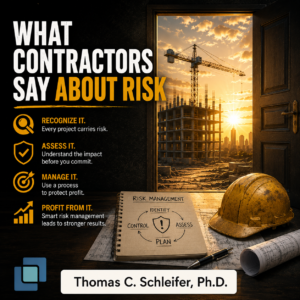
Vacation schedules have interrupted our strategic planning series, so we are repeating an important message on risk. If risk recognition and assessment is so fundamental to the construction transaction, why do so few contractors engage in formal risk management? As I said when this message appeared three years ago, this is a question I have been asking for 30 years. To begin with contractors are type A risk takers or we wouldn’t be in the business. As professional risk takers we should be seeking out information about recognizing and assessing risk. So why isn’t every contractor doing that? Here’s how contractors across the country see risk management.
I asked: Do you think this is a risky business? How do you analyze the risks you are taking when you sign a contract?
CONTRACTOR #1. “You bet this is a risky business. Every time my team starts a new project I see it like a sports event. We’re challenged to complete the project and make a profit while we’re at it. That’s not always a foregone conclusion. Too many things can go wrong and often do. But we enjoy the challenge and sometimes win and sometimes lose. That’s the business.”
CONTRACTOR #2. “Risk is built into this business but we know what we’re capable of and try to stick to our knitting. We can’t always do that and keep working. That’s when it gets a little dicey. A certain amount of the work we feel we have to take we know we can’t make money on. But it keeps us busy and pays the bills, so we get on with it even though we know it’s a big risk.”
CONTRACTOR #3. “I can look at the plans and know if we can make any money with them. I don’t need a statistical analysis of all the bits and pieces. And I know when it’s time to take a chance. Some work may be risky but if it advances our reputation and supports growth, I’m willing to take the chance– ‘No risk, no reward. You can’t play it safe and survive in this racket.”
CONTRACTOR #4. “I have my marketing department submit all bids that might be outside our normal scope of work to our executive committee. My ops guy, marketing department, estimators, and division chiefs all take a look and let me know what they think. But I have the last word. You have to trust your gut, and you have to be willing to take some risk.”
CONTRACTOR #5. “Over the years we’ve made too many mistakes and got in over our head a few times. Now we subject every potential job to a careful analysis much like the one you described in your books. It’s the unexpected issues and risks that kill profits. We’ve never used the screening mechanisms you recommend but I’m going to pass them along to my CFO and see how he can apply it to our risk assessment process.”
CONTRACTOR #6. “My senior management team has been together for almost 25 years. Together we look at the plans and specs for a potential job and can make a go/no go decision based on our collective intuition. But I will say this. As my trusted team of managers begins to retire, I intend to formalize our risk assessment along the lines you have laid out. Our hard-earned institutional knowledge will no longer be there to protect us as these people retire. It will be time to replace it with a data driven scientific approach. I’ll let you know how we do.”
How Art Fits In
To develop a complete mind: Study the science of art and study the art of science. (Leonardo da Vince)
Listening to these contractors I began to understand why most contractors don’t employ formal risk assessment procedures from the start. Some contractors rely on their experience and instinct to decide if a job is right for them. Others rely on the collective institutional instincts of their managers to make the right call. Experience-informed instinct is the ART of decision making. All successful contractors seem to have this intuitive skill along with some of their management team. They employ the art of risk assessment successfully until their company reaches a certain size. Then complexity begins to overwhelm their intuitive ability to recognize and assess risk. That is when a data driven approach is required to uncover hidden risks. Only a scientific process can reliably identify all risks and accurately assess each risk’s impact on profit.
How Science Fits In
“Management is above all, a practice where art, science, and craft meet.” (Henry Mintzberg, author of Business and Management)
All sound management decisions require analytical and empirical skills (science). They also require intuition and imagination (art). As your company grows it becomes increasingly important that your management skills grow with it. Risk assessment has always been an important part of your job. But as the projects become more complex, data driven information is the only sure way to identify unforeseen risks. Readers may want to review the Project Selection Program that was introduced in these messages a few years ago and is available free at: https://tools.simplarbenchmarking.org/projectselection. The program dramatically increases the odds of selecting and completing each project for a profit.
Next week we will get back to planning and go through the step-by-step process required to create a powerful Strategic Plan and how to implant the resulting shared mission down through every department of the company. Success is often defined as achieving your objectives. A carefully conceived Strategic Plan is the magic potion of success.
For more information on risk management, read more at: RISK
For a broader view of the project selection program, read more at: PROJECT
To receive the free weekly Construction Messages, ask questions, or make comments contact me at research@simplarfoundation.org.
Please circulate this widely. It will benefit your constituents. This research is continuous and includes new information weekly as it becomes available. Thank you.