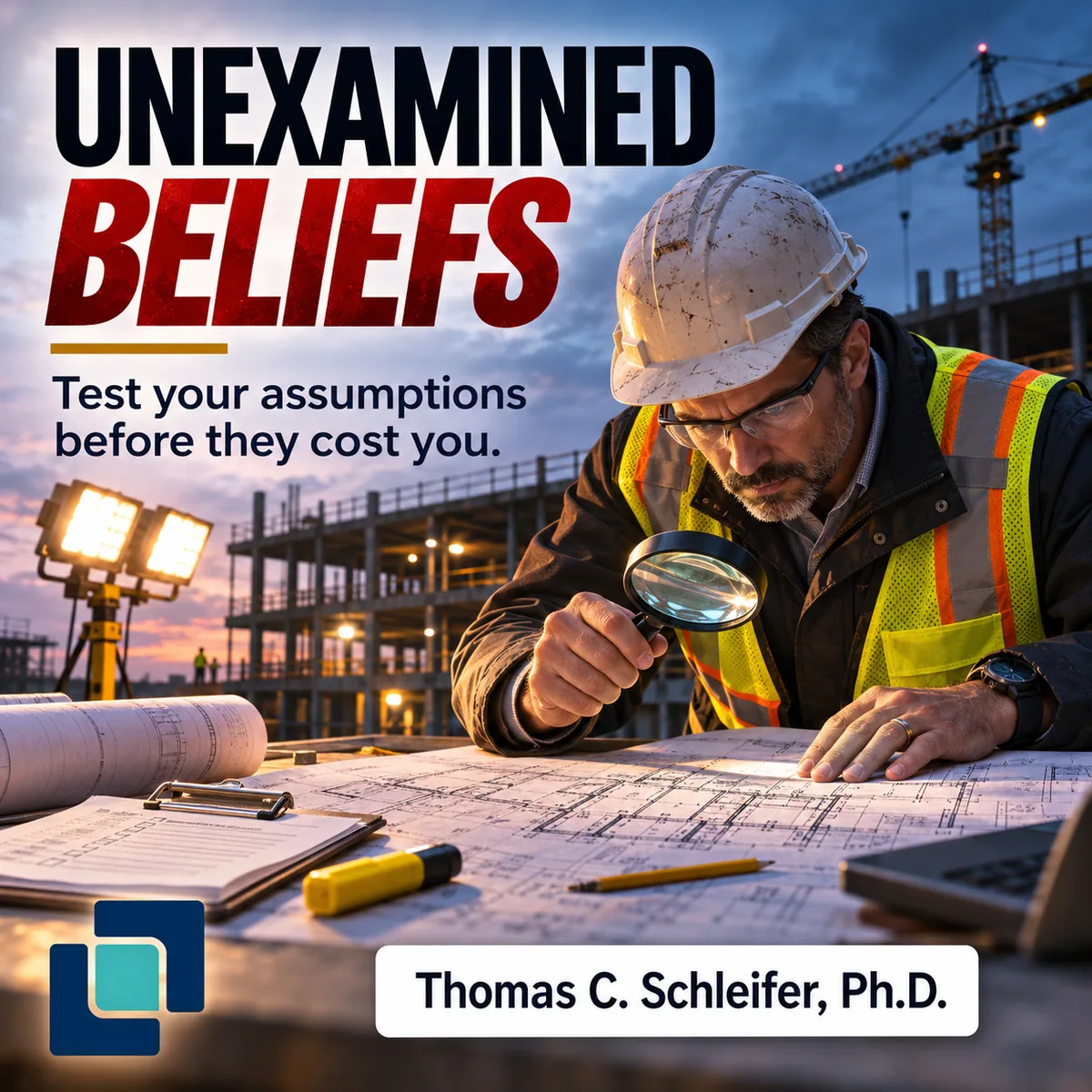
A few years back I introduced the concept of unexamined beliefs into the discussion about managing construction. Before this year’s message series comes to an end, I would like to broaden that discussion a bit for a reminder about how unexamined beliefs can lead to bad management decisions.
The Risk of Unexamined Beliefs
Managers in construction make decisions in an environment defined by uncertainty. Material prices fluctuate, weather changes, subcontractors miss deadlines, and designs evolve. To act quickly, managers rely on experience and assumptions. These mental shortcuts can be useful, but when beliefs go unexamined, they can turn experience into a liability. A belief that once seemed sensible may no longer fit the project, the workforce, or the market. Unexamined beliefs can result in poor estimates, unsafe practices, damaged relationships, and avoidable financial losses.
Low Bid Belief
One common belief is that the lowest bid represents the best value. A contractor under pressure to control costs may choose the cheapest subcontractor without closely examining staffing, experience, exclusions, or financial stability. The supposed saving disappears if the subcontractor falls behind, produces defective work, or submits costly change requests for items omitted from the bid. In the worst case, a replacement must be hired mid-project, disrupting other trades and interrupting the schedule. A better decision considers demonstrated capability, schedule, quality, and risk. The lowest price may still be the right choice, but only after its assumptions have been tested.
Aggressive Schedule Belief
Another dangerous belief is that an aggressive schedule will automatically produce a faster project. Managers may assume that crews can simply work harder or that delays can always be recovered later. This thinking can lead them to compress activities without accounting for inspections, procurement lead times, trade coordination, or the physical limits of the site. When the plan proves unrealistic, overtime and overlapping work can increase congestion, errors, and fatigue. Instead of gaining time, the project may lose it through rework and accidents. Scheduling is challenging and must be grounded in input from the people who will perform the work and in realistic assessments of dependencies and constraints.
Beliefs About Safety
Unexamined beliefs can also shape safety decisions. A supervisor who believes that experienced workers do not need reminders may overlook routine hazards. Another may treat near misses as evidence of working safely rather than warnings of a system failure. These assumptions discourage reporting and make it harder to identify risks before someone gets hurt. The question is not whether a crew has worked safely in the past, but whether the current task can be performed safely today.
Personnel Bias
Beliefs about people can be costly. A manager might assume that a quiet employee has nothing useful to contribute, that a younger worker lacks practical judgment, or that a subcontractor raising concerns is merely making excuses. These assumptions filter out information precisely when a project needs it. Inviting questions and responding respectfully does not mean accepting every suggestion. It means judging ideas on evidence rather than on the status or personality of the person presenting them.
Self-Confidence
Past success can reinforce blind spots. A company that completed several profitable jobs using informal coordination may conclude that detailed planning is unnecessary. Yet those earlier projects may have had simpler designs, more reliable partners, or unusually favorable conditions. When the company takes on a larger or more complex project, the same practices may fail. Managers need to distinguish what genuinely worked from what merely coincided with a good outcome.
Examining the Unexamined
Testing beliefs does not require endless analysis. Before a major decision, a manager can identify the assumptions behind it and ask what evidence would challenge them. For example: What must be true for this schedule to work? What costs are excluded from this bid? What are we assuming about the availability of labor? Who sees the situation differently? Short pre-construction reviews, regular site meetings, documented lessons learned, and comparisons between estimates and actual results make these questions part of routine management. When new evidence appears, leaders should be willing to revise the plan rather than defend the original decision at all costs.
Examination Reduces Risk
In construction, experience is indispensable, but experience alone is not a guarantee of sound judgment. Unexamined beliefs become dangerous when they are treated as facts and protected from challenge. By making assumptions visible, seeking perspectives from across the project, and adjusting decisions as conditions change, managers can reduce risks. The goal is not to eliminate judgment; it is to make judgments more reliable. In an industry where decisions affect budgets, livelihoods, and safety, that discipline is a practical necessity.
For more information on unexamined beliefs, read more at: BELIEFS
For a broader view of risk, read more at: RISK
To receive the free weekly Construction Messages, ask questions, or make comments contact me at research@simplarfoundation.org.
Please circulate this widely. It will benefit your constituents. This research is continuous and includes new information weekly as it becomes available. Thank you.