
TEMPE, Ariz., Nov. 12, 2026: Simplar Foundation today announced the release of Schedule Duration and Labor-Curve Outcomes, Report 3 in Volume 1 of Multiskilling in the U.S. Construction Industry. It is the last of the volume's six reports to be released, and all six are now available through the Multiskilling Knowledge Center.
The research was conducted by a multi-institutional team of construction faculty, researchers and doctoral students representing the University of Kansas, the University of North Carolina at Charlotte, Arizona State University and Simplar Foundation.
“Volume 1 set out to measure multiskilling where it actually happens, on active U.S. jobsites, and to document the surrounding training infrastructure it takes for contractors to implement it successfully on their projects,” said Rebecca Kassa, Ph.D., senior researcher at Simplar Foundation. “With this final report, workers, contractors, owners and policymakers have the complete evidence base in one place at the Multiskilling Knowledge Center.”
Schedule Duration and Labor-Curve Outcomes drew on day-by-day labor records from 18 projects built by 11 contractors in nine states and Washington, D.C., including bridges, hospitals, manufacturing facilities and a wastewater treatment plant. The analysis focused on each project's core crew: 183 workers who recorded about 89,620 hours. Every project used a multiskilled labor strategy, in which qualified workers moved between trades as the work required; multiskilling made up about 17% of core hours, across 80 trade combinations in 18 trades. The research team kept the same workers, hours and work, limited each worker to one trade, and estimated how much longer the same crew would take, or how many workers would have to be added to keep the recorded schedule.
Key findings include:
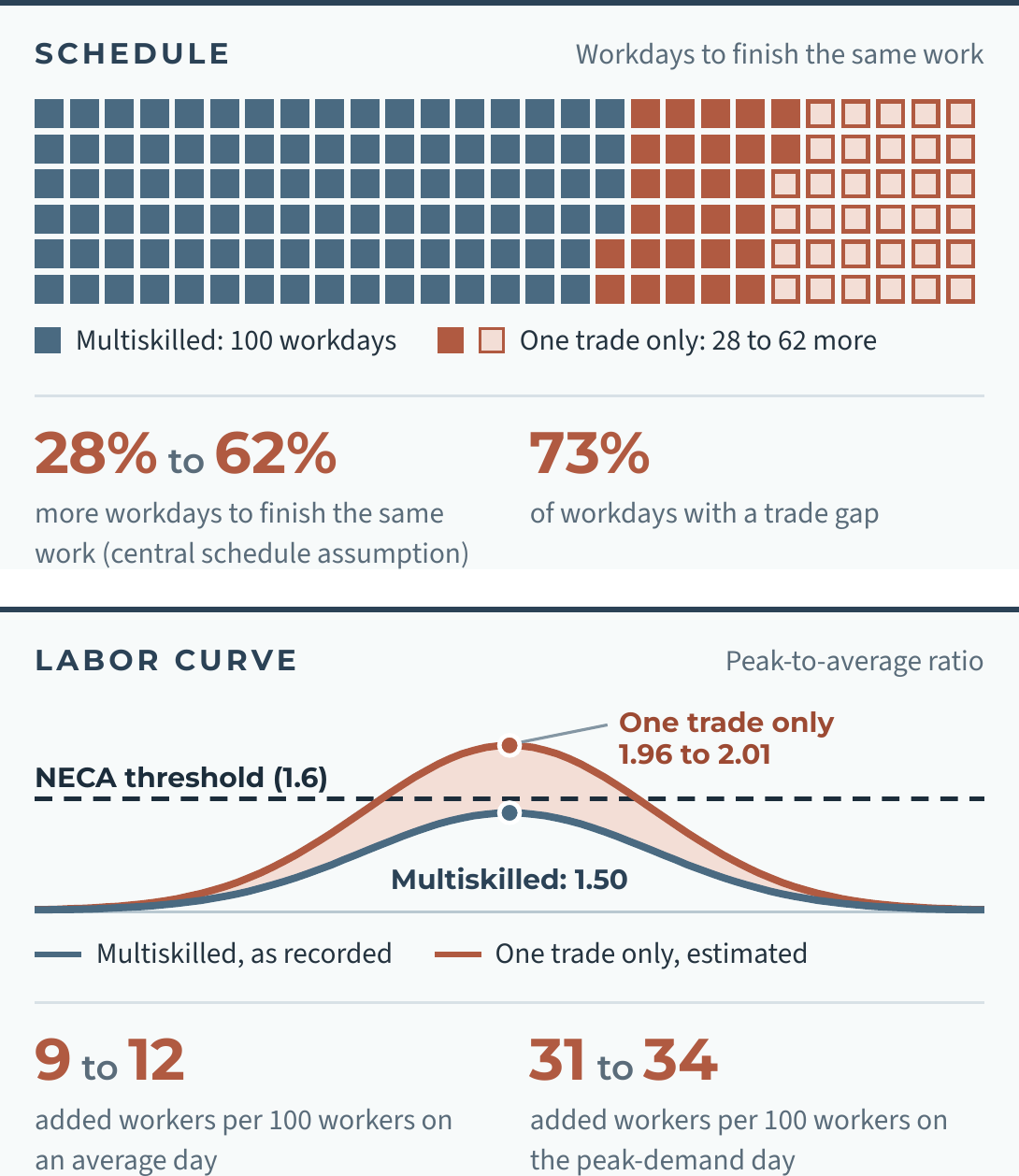
- More workdays with the same crew: Limiting each worker to one trade would have required an estimated 28% to 62% more workdays to finish the same work. Put the other way, the multiskilled crews finished in about 22% to 38% fewer workdays. All 18 projects showed an increase.
- Trade gaps on most workdays: On about 73% of recorded workdays, at least one trade would have had more work than its workers could cover, even when the crew had enough workers overall.
- Peak days drove staffing needs: Keeping the recorded schedule would have required about 9 to 12 added workers per 100 core workers on an average day and 31 to 34 on each project's peak-demand day. Peak staffing would have reached about twice the average, a level prior industry research associates with productivity losses of about 15% to 20%.
- Crew makeup was not a substitute: Reassigning the same workers, with hindsight, to the single trades that kept the impact smallest cut the schedule effect by more than half, but trade gaps still occurred on about 73% of workdays and peak-day staffing needs barely changed.
- Findings held under a stricter test: When only half of the recorded multiskilling hours were treated as necessary, limiting workers to one trade still required an estimated 19% to 44% more workdays.
The results are modeled estimates built from recorded hours, not measured delays, hiring or productivity changes. The research team sought out projects where multiskilling was in use, so the 18 records are detailed cases rather than a representative sample of U.S. construction. The report did not evaluate specific laws or measure the effects of prevailing wage policy.
Together, the six reports in Volume 1 draw on jobsite observations, controlled field trials, project labor records, employer interviews and training-facility visits, peer-reviewed literature and contractor safety data. Each addresses a different question:
- Report 1: Work-Time Utilization and Staffing Level Impacts in Construction Crews
How multiskilling affects productivity at the crew level. Across 60 crews observed on 36 projects in 24 states, multiskilling raised the share of crew time spent directly advancing construction work by 39% and cut idle and waiting time by 68%, compared with the same crews limited to their primary trades. Keeping the same work sequence with each worker limited to one trade would have required about 45% to 72% more workers. - Report 2: Productivity in Multi-Trade Construction Workflows
Productivity loss associated with repeated trade-to-trade handoffs. Controlled field trials and scenario modeling found that reducing repeated handoffs could cut crew-level production time by about 30%, the equivalent of about 43% more installed work in the same time, for the high-handoff work sequence studied. Two multiskilled workers completed a seven-trade sequence that the one-trade workflow staffed with 12 workers and 10 handoffs. - Report 3: Schedule Duration and Labor-Curve Outcomes
How multiskilling affects schedule and staffing. Limiting workers to one trade would have required an estimated 28% to 62% more workdays, or added workers on most workdays to keep the same schedule. - Report 4: How Construction Employers Develop, Verify, and Sustain Workforce Capability
How employers build multiskilled workforce capability. Research involving 48 organizations, 80 interviews and seven training-facility tours documented how employers recruit, develop, assess, document, deploy and refresh workforce capability. These systems can give workers more ways to earn, longer stays on projects and paths to advancement. - Report 5: A Comprehensive Review of Prior Evidence
What earlier research found. Of 59 peer-reviewed studies published between 1998 and mid-2026, more than 95% described multiskilling as valuable or reported potential benefits, and none concluded that it produced an overall disadvantage. None directly measured performance on an active U.S. construction site. - Report 6: Contractor Safety Context
Safety context of participating contractors. Fifteen participating contractors reporting about 33.2 million employee hours had average recordable and lost-time injury rates substantially below tailored national benchmarks, with no fatalities. The report presents these results as context, not evidence that multiskilling caused better safety performance.
Across the volume, the evidence supports using multiskilling where workers' added capability is verified and the work calls for it. Multiskilling does not mean every worker performs every task, and it does not replace specialized trade expertise. The reports recommend that contractors plan labor by trade and by workday, that owners consider each competing contractor's labor strategy in their selection decisions, and that workers, employers and training providers tie added skills to the trade gaps that recur on real projects. Safety, quality, licensing, inspection and supervision requirements must remain in place.
“For owners, considering each competing contractor's labor strategy when making the selection decision, and then measuring the result on the project, is a practical place to start,” said Kenn Sullivan, Ph.D., professor at Arizona State University.
The research team also identified priorities for further study, including direct measurement of productivity and crowding on high-demand days and extension of the labor-record analysis to more contractors, regions and project types.
Associated Builders and Contractors (ABC) financially supported the research. The research team controlled the study methods, analysis, interpretation and publication decisions.
Schedule Duration and Labor-Curve Outcomes is available at simplarfoundation.org/multiskilling/schedule-labor-curve/. The complete Volume 1 reports, study summaries and related resources are available through the Multiskilling Knowledge Center at simplarfoundation.org/multiskilling/. Members of the research team are available for interviews through press@simplarfoundation.org.
About Simplar Foundation
Simplar Foundation advances practical, evidence-based research and education intended to improve workforce, organizational and project outcomes. The foundation works with academic and industry partners to translate rigorous research into knowledge that can be used by practitioners, decision-makers and the public. Learn more at simplarfoundation.org.